
AI and Your Health After 50: What's Helpful, What's Hype, and What to Tell Your Doctor
Here is a number worth knowing.
14% of adults over 50 have used an AI technology to receive health-related information. Of those, nearly half — 47% — said that a human interaction in person or by phone would have been better for that purpose.
(University of Michigan National Poll on Healthy Aging, 2025)
That data point captures something important. People are turning to AI with health questions. Some are finding it helpful. Many recognize its limits. And the question of when AI helps and when it doesn't is one of the most important ones you can answer before you need the answer in a hurry.
This post is our honest, research-backed attempt at that answer.
The Honest Starting Point
AI in healthcare is not science fiction. It's already embedded in tools millions of people use every day — often without realizing it. The question isn't whether AI has a role in health after 50. It clearly does. The question is: what role is appropriate, and where does the responsibility remain with you and your healthcare team?
We'll start with what's genuinely working.
What AI Health Tools Are Doing Well for Adults Over 50
1. Wearable Health Monitoring
This is the category with the strongest evidence and the most practical daily value.
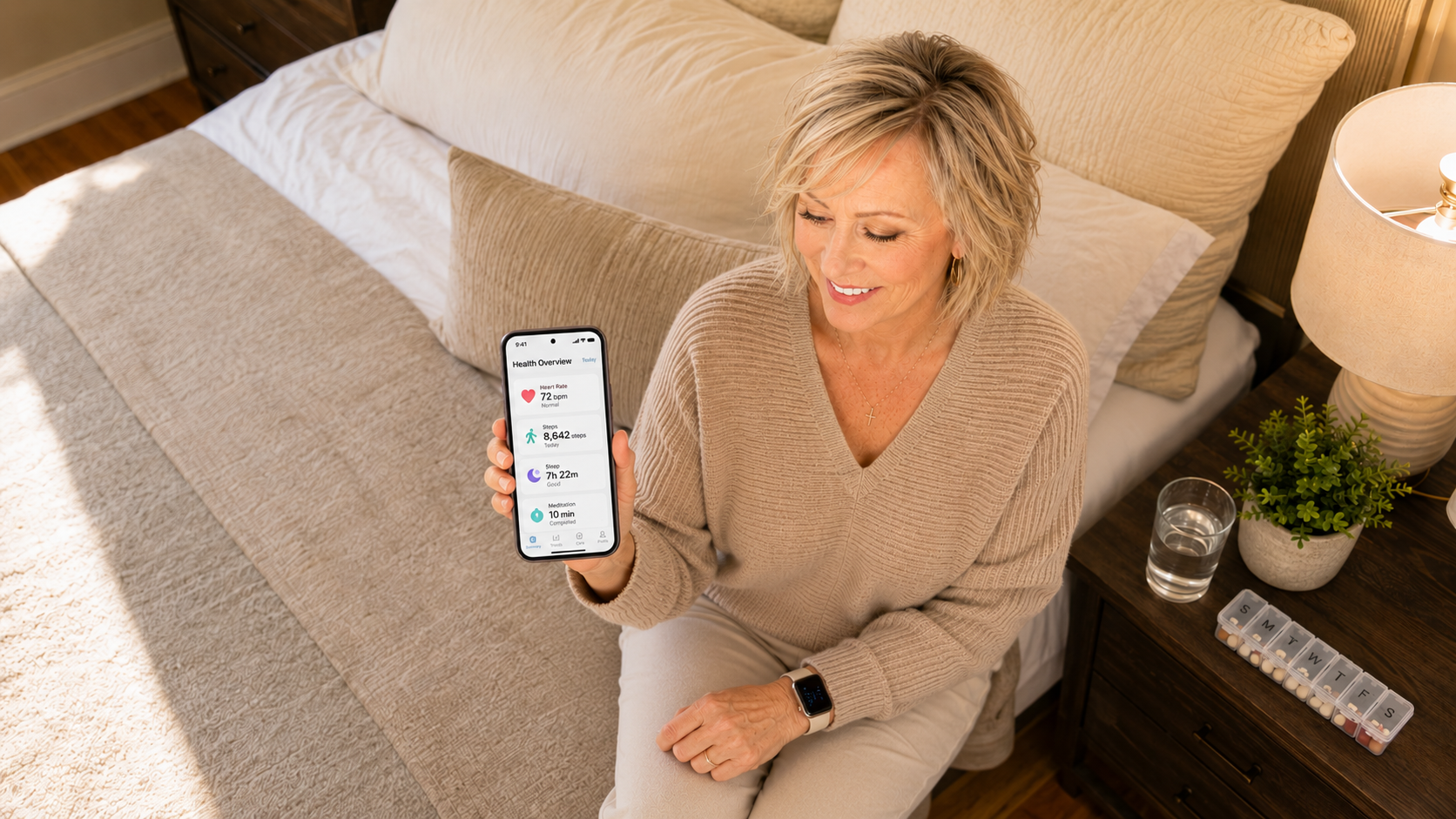
Smartwatches and health monitors — including Apple Watch, Fitbit, and newer health-focused devices — use AI to track, analyze, and alert based on your body's data in real time.
What they can currently do:
Monitor heart rate continuously and detect irregular rhythms
Track sleep quality and duration
Count steps, measure activity levels, and estimate calories
Detect falls and send automatic emergency alerts
Monitor blood oxygen levels (SpO2)
Generate ECG readings — Apple Watch Series 9+ carries FDA clearance for its ECG app
A 2025 study published in Nature Communications (University of Arizona, March 2026) described an AI-powered wearable sleeve that detects subtle changes in gait, symmetry, and step variability — warning signs of frailty — before a fall ever happens. The device reduced the data transmitted to clinicians by 99% while still providing accurate early warning indicators. According to researcher Philipp Gutruf, "Right now, we often wait for a fall or hospitalization before we assess a patient for frailty. This device allows clinicians to intervene early, potentially preventing costly and dangerous outcomes."
For context on why this matters: frailty affects approximately 15% of U.S. residents 65 and older, and falls remain one of the leading causes of injury-related death in older adults.
A 2026 report from MySeniorCareHub found that in-home safety programs using AI remote monitoring reduced dangerous falls by 40% among participants, and cut emergency room visits by 51%.
🟢 Recommendation: If you live alone, travel frequently, or have any cardiovascular or mobility concerns, a quality health-monitoring wearable is worth serious consideration. Discuss options with your doctor — some Medicare Advantage plans now cover certain devices.
2. Medication Reminders and Routine Management
Voice assistants (Alexa, Siri, Google Assistant) and dedicated apps like Medisafe use AI to:
Remind you to take specific medications at specific times
Remind you to refill prescriptions before you run out
Track whether you've taken a dose (with the right setup)
Alert caregivers or family members if a dose is missed
According to the Advance Healthcare Marketing research (December 2025), medication management via AI-assisted tools is one of the most adopted applications among seniors — because it solves a real, daily problem without requiring significant technical learning.
🟢 Recommendation: This is low-risk, high-value AI use. If you're managing multiple medications (as most adults over 50 are), a voice-activated reminder system pays for itself in reduced missed doses and associated health complications.
3. Telehealth Scheduling and Coordination
Many healthcare providers have integrated AI into their patient portals — to schedule appointments, send pre-visit questionnaires, provide after-visit summaries, and coordinate follow-up reminders.
These tools are largely invisible to patients. You may be using them already. They improve the efficiency and continuity of your care without requiring you to do anything differently.
🟢 Recommendation: When your healthcare provider offers a patient portal, use it. The AI working in the background is helping ensure your care is more coordinated.
4. Preliminary Information Gathering
Adults over 50 are using ChatGPT and similar tools to research:
What a medical term means before an appointment
How a specific medication works and what its common interactions are
What questions to ask a specialist before seeing them
How a certain procedure is typically performed
What to expect during a recovery period
Used this way — as preparation for a professional conversation, not a replacement for it — AI is genuinely helpful. It helps patients arrive at appointments better informed and better able to advocate for themselves.
🟢 Recommendation: Before your next significant medical appointment, type your main concern into ChatGPT with the prompt: "I'm meeting with my [specialist type] about [condition/symptom]. What are the most important questions I should ask?" Then bring that list to the appointment.
What AI Health Tools Cannot Do
This is the part that matters most, and it needs to be stated clearly.
AI cannot diagnose you. Even the most sophisticated AI health platforms are explicit about this limitation. They analyze patterns in data. They surface possibilities. They identify when something is outside a normal range. They cannot replace a physician who examines you, reviews your full medical history, and applies clinical judgment developed over years of training and practice.
AI health information is general; your situation is specific. When you ask ChatGPT about symptoms, it provides answers based on statistical patterns across millions of data points. It doesn't know your age, your current medications, your allergies, your surgical history, your family history, or the particular details that matter most to your care.
AI can hallucinate in healthcare contexts. The same tendency to generate confident-sounding incorrect answers that applies in other AI contexts applies in health contexts too — and the stakes are higher. A wrong answer about a medication interaction, a misidentified symptom, or an inaccurate description of a procedure carries real risk.
A separate concern: privacy. Health data is among the most sensitive information you generate. Before using any AI health app or wearable, read the privacy policy — specifically looking for:
Whether your data is sold to third parties
Whether it qualifies for HIPAA protection (many consumer wellness apps do not)
How long your health data is retained
Whether you can delete it
A note from the AARP AI research (2025): roughly half of adults over 50 cite data privacy and security as a primary reason for hesitating to adopt new technology. When it comes to health data specifically, that caution is well-placed.
The Three-Question Test
Before acting on any AI-generated health information, apply these three questions:
1. Is this information general or specific to me? General information ("high blood pressure is often managed with lifestyle changes and medication") is more reliable than AI-generated specific advice ("based on your symptoms you probably have X"). Use AI for the former; see a doctor for the latter.
2. Would my doctor agree? If the information seems to contradict what your doctor has told you, don't assume the AI is right. Call your doctor's office. Your doctor knows you; the AI does not.
3. Am I using this to inform a conversation or replace one? AI as a preparation tool: appropriate. AI as a substitute for professional medical care: not appropriate.
AI Scams Targeting Health Concerns: A Real Warning
This section is important enough to include directly.
In 2025, Americans aged 60 and older reported $7.75 billion in losses to online fraud — a 59% increase from the prior year (FBI Internet Crime Report, 2025). A significant and growing portion involves AI-generated content: voice clones impersonating family members, fake websites mimicking real healthcare providers, and AI-written phishing emails about Medicare or insurance.
Specific red flags to know:
Unsolicited calls or emails about your Medicare benefits, asking you to "confirm" personal information
Offers of free medical devices, supplements, or consultations in exchange for your Medicare or insurance number
Urgent messages warning that your benefits will be cut unless you respond immediately
AI-generated voice messages that sound like a doctor, nurse, or insurance representative you know
If you receive any of these: hang up or delete, and call your doctor's office or insurance provider directly using the number on your insurance card.
Our Approach at Fogey Freedom
Pete and I use health technology as part of a broader framework that keeps human relationships at the center.
Our smartwatches remind us to move, log our sleep, and have — more than once — flagged irregularities worth mentioning to our doctors. We use apps to keep medication schedules organized. We've used ChatGPT to research questions before specialist appointments.
And we call our doctors when something concerns us, because no algorithm replaces a physician who has known you for years and understands what's normal for you specifically.
That balance — using AI to support independence, using professionals to guide care — is the right approach. It's the one the research consistently points toward, and the one that has worked in our own lives.
Health after 50 is not a fixed destination. It's an ongoing practice. The best tools — including AI — are the ones that help you stay in that practice longer, more comfortably, and with more independence.
References:
University of Michigan Institute for Healthcare Policy and Innovation. National Poll on Healthy Aging: How Older Adults Use and Think About AI. July 2025. https://ihpi.umich.edu/national-poll-healthy-aging/national-findings/how-older-adults-use-and-think-about-ai
University of Arizona Gutruf Lab. AI-Powered Wearable Boosts Preventative Care for Elderly. Nature Communications, published via UA News, March 2026. https://news.arizona.edu/news/ai-powered-wearable-boosts-preventative-care-elderly
MySeniorCareHub. 24/7 Virtual Care Monitoring: Why It's Critical for Seniors in 2026. April 2026. https://myseniorcarehub.com/blog/247-virtual-care-monitoring-getting-more-critical-for-seniors-in-2026/
AARP Research. Navigating the World of AI: Attitudes, Awareness and Openness Among Adults Ages 50-Plus. Washington, DC: AARP Research, September 2025. https://doi.org/10.26419/res.00888.001
Advance Healthcare Marketing. Seniors and AI: How Healthcare Marketers Can Win in 2026. December 2025. https://www.advancehealthcaremarketing.com/insights/seniors-and-ai-how-healthcare-marketers-can-win-in-2026/
FBI Internet Crime Complaint Center. 2025 Internet Crime Report. April 2026. https://www.ic3.gov
Bitdefender. Older Adults Lost Billions to Scammers Last Year, FBI Warns. May 2026. https://www.bitdefender.com/en-au/blog/hotforsecurity/older-adults-lost-billions-to-scammers-2026
JMIR Aging. Exploring Older Adults' Perspectives and Acceptance of AI-Driven Health Technologies. February 2025. https://aging.jmir.org/2025/1/e66778/
PubMed / Ageing Research Reviews. Artificial Intelligence for Fall Detection in Older Adults: A Comprehensive Survey. January 2026. https://pubmed.ncbi.nlm.nih.gov/41265569/
Bethesda Health. How Seniors Can Use AI Tools in Their Everyday Life. January 2026. https://bethesdahealth.org/blog/how-seniors-can-use-ai-tools-in-their-everyday-life/
